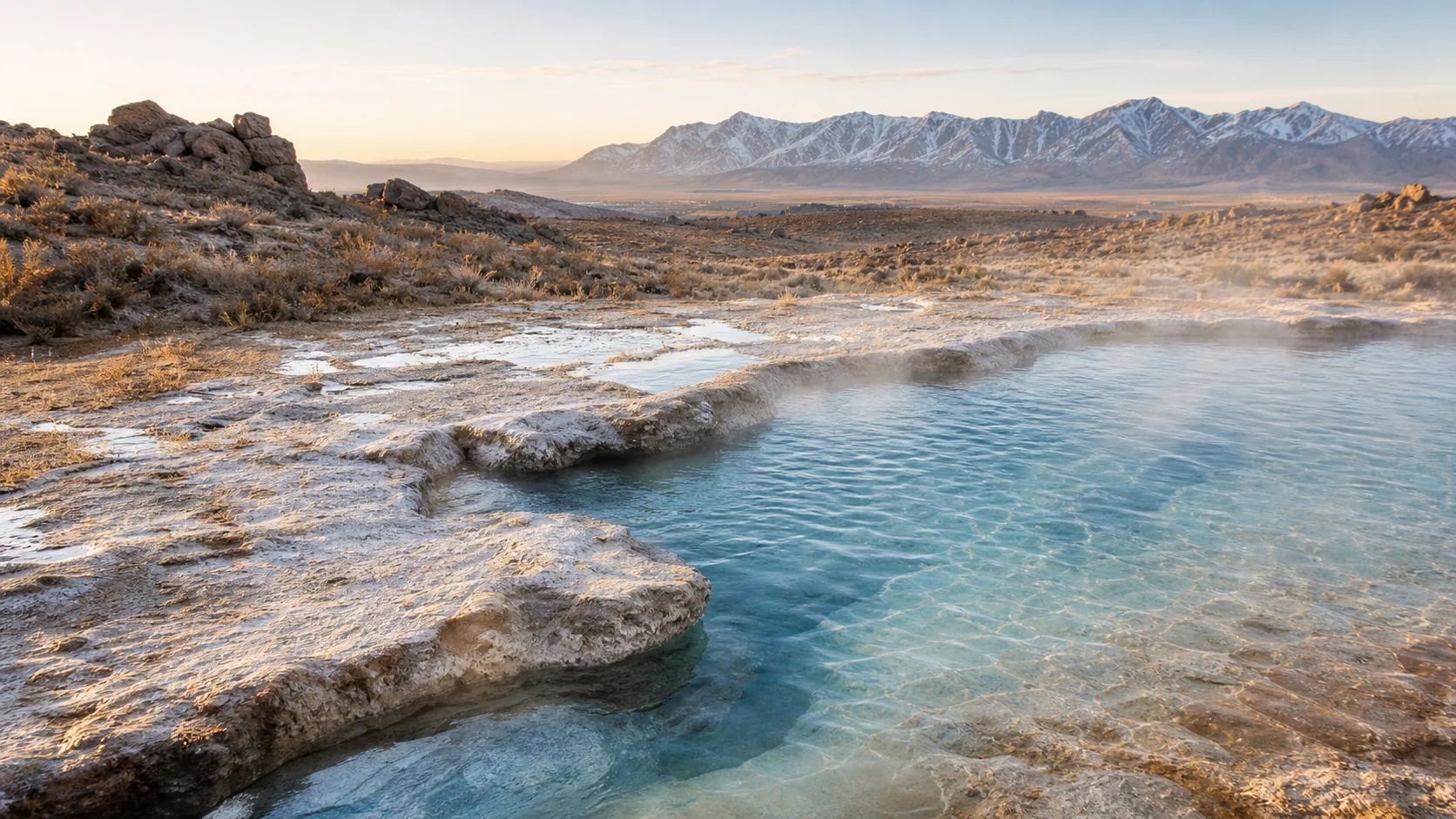
Travertine Hot Springs is the wild Eastern Sierra soak that everyone shares photos of: a hillside of travertine terraces above the Bridgeport Valley, with the Sawtooth Ridge and the Sierra Crest filling the western horizon. The mineral water emerges at the top of the formation at 180 F and cascades downhill through pools that visitors and natural deposition have shaped over decades.
The geology is the same that built California history. In the mid-1890s, 60 tons of travertine was mined from this site and used to face the interior walls of San Francisco City Hall and other public buildings. The same travertine continues to grow today, slowly, as calcium carbonate precipitates out of the cooling water. This is why soap is prohibited at the springs: detergents disrupt the mineral chemistry and damage the terraces.
The pool inventory is informal. A small concrete tub at the top of the hill captures the hottest source water (around 110 F, holds two to three people). A series of natural travertine pools sit below it, cooler as you descend (95 F to 105 F). Visitors regularly rebuild and adjust the lower pools with rocks; the BLM permits this informal maintenance as long as the travertine itself is not damaged.
Practically, Travertine works because of where it sits. Two miles south of Bridgeport on US-395, the dirt access road (Jack Sawyer Road) heads east off the highway and ends at a small parking area below the springs. The hike to the pools is a short five to ten minute walk. Bridgeport has a restored 1877 hotel and a few restaurants, but there is no lodging at the spring itself. Most visitors basecamp in Bridgeport or pair the soak with a Mammoth ski trip 60 miles south.